
Procurement is not dealing with a single disruption. It is managing multiple forces simultaneously, with no clear end point.
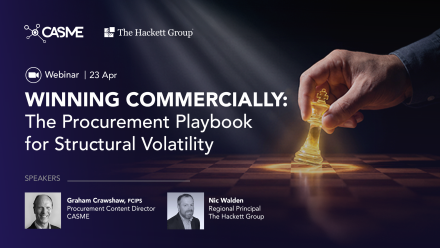
That was the focus of our latest joint webinar with The Hackett Group, ‘Winning Commercially: The Procurement Playbook for Structural Volatility’. The fourth in the Going for Gold series, this session brought together Graham Crawshaw (Content Director at CASME) and Nic Walden (Senior Director at The Hackett Group), drawing on current benchmarking data, proprietary CASME and Hackett analysis, and live audience polling across three interlocking themes:
- Geopolitical and energy disruption
- AI's real role in procurement decision-making
- The mounting cost shock in technology equipment.
More than 80 procurement professionals joined from across North America, Europe, Asia and Latin America, all facing the same underlying pressure: too many variables, too little certainty, and a stakeholder community that expects Procurement to have the answers.
"One particular aspect would be fine," reflected Graham Crawshaw. "But it's these multiple impacts hitting simultaneously that are really causing the chaos. And if anyone is struggling with the volatility at the moment — that's understandable. That is exactly what we're seeing."
The Middle East, Energy, and the Real Cost of Waiting
At the time of broadcast, geopolitical instability remained acute and unresolved. The Strait of Hormuz remained closed to commercial traffic, with a ceasefire in place but only informally extended and with no diplomatic resolution in sight. Negotiations between Iran and the US had stalled; the two sides did not meet in Pakistan on 22 April as expected. President Trump publicly stated there was ‘no end date’ and ‘no timeline’. Even within the ceasefire period, disruption persisted, with ships being seized and exchanges of gunfire continuing.
The commodity impact is already pronounced. As of 23 April, US WTI crude was trading at $93 per barrel, up 70% since the start of the year, while UK Brent had reached $102, a 74% increase. TTF gas stood at $45, up 67%. US natural gas remains the notable outlier, broadly flat since December 2025. For the rest of the world, there is no equivalent buffer.
The supply constraints are substantial. Approximately 20% of global LNG, 10% of oil, one-third of fertiliser and helium supply, and 10% of aluminium have been removed from international markets. Force majeure clauses have been invoked across multiple supplier contracts.
In response, Asian economies, without the depth of strategic reserves that China maintains, have shifted energy demand toward coal and are now competing directly with European and US buyers for tanker cargoes. This intensifying global competition for energy is pushing prices higher across markets.
Nic Walden outlined the IMF's April 2026 forecast revisions: a 1% increase in global CPI and a 0.2 percentage point reduction in global growth; headline figures that appear manageable, perhaps even conservative. The regional distribution, however, is deeply uneven. The US is least impacted, with China showing similar resilience. By contrast, the UK and much of Europe, already operating from a weaker base, face a more pronounced shock, with disruption of this scale potentially tipping several countries, including Germany, into recession. The primary beneficiaries are fossil fuel exporters, including the US, Russia, Argentina, Brazil and Canada.
At $100 oil, cost increases of between 20% and 40% are within scope across fuel-linked input categories such as lubricants, fertilisers, plastics, rubber and chemicals, creating direct implications for procurement teams exposed to these supply chains.
Some market indicators suggest cautious optimism. Betting markets have placed a 56% probability on the Strait reopening by the end of May 2026. But even if that scenario plays out, the damage will be long-lasting. Rerouting logistics, rebuilding infrastructure and reactivating disrupted supply chains will take months rather than days. As Graham noted, the secondary effects across indirect categories will take time to materialise fully: "It's almost what that knock-on impact will be. It's going to take quite some time before it really flows through to different commodities, different products."
Where the Impact Is Landing
CASME's member benchmarking, published in the week preceding the webinar, confirms that the effects are already being felt, albeit unevenly, across indirect categories. Utilities and energy show the highest sensitivity, with 40% of members reporting significant impact. Logistics and freight, alongside MRO, are also rated High, with logistics alone seeing 32% significantly impacted. Business travel and facilities fall into the Medium range, while IT, cloud and cyber services, events, legal and compliance remain Low to Very Low for now.
Category pressure tracking data, however, suggests this position is far from static. Between January 2023 and January 2026, the inflationary impact of government policy, tariffs, trade measures and currency fluctuations moved from the lowest-ranked factor to second place - the most dramatic shift recorded in the tracker over that period.
Audience polling highlights where the impact is most acute. For direct spend, energy prices dominate (48%), followed by supply disruption and commodity pricing (both 30%). For indirect spend, the picture shifts: energy still leads (36%), but higher supplier costs (32%) and economic uncertainty (30%) become more prominent relative to their direct counterparts.
Live Poll: Where are you seeing the greatest impact from recent events? Please select all that apply
Hackett's parallel polling of its client base presents an even starker view. For indirect spend, higher supplier costs and prices rank as the top concern at 88%, followed by energy at 75% and supply disruptions at 63%. The disparity between direct and indirect concern regarding supplier costs, i.e. 33% versus 88% in the Hackett data, points to a structural gap.
Nic was reflective about why and attributed this to differences in maturity. The tools for managing direct spend volatility, such as indexation, hedging, SRM programmes, longer-term commodity-linked contracts, are broadly in place. Equivalent disciplines on the indirect side are frequently less consistently embedded. "On the indirect side, we have so many suppliers," he observed. "The practices often aren't as mature or as consistently in place to manage through volatility the way direct teams do."
Graham reinforced this point through CASME's benchmarking. In categories with established contract indexation, logistics being the clearest example, the adjustment mechanism exists, even if the cost impact must still be managed. "For most category managers, whilst the shock around logistics is a high-cost impact, it's managed. But there are many other indirect commodities that really aren't managed as thoroughly."
For procurement teams responsible for indirect spend, the actions are the same as for direct spend, just less consistently applied: map your exposure, build your cost models, index where you can, and engage with suppliers before cost increases are formalised.
AI in Procurement: From Conversation to Consequence
As Graham observed, the AI topic is impossible to avoid on the conference circuit right now. Yet the distance between conversation and commercial impact remains significant.
CASME's benchmarking of members tells a grounded story of where AI is being used. Adoption is led by spend data analysis and benchmarking at 77%, followed by market research and analysis at 60%, category strategy planning and management at 40%, and both sourcing/negotiation optimisation and contract development at 38%. These are predominantly analytical and preparatory activities; the tasks that consume time before the commercial work begins. It is here that efficiency gains are most tangible, and where teams are seeing measurable benefit.
The barriers, however, are equally well defined. Data security and privacy leads member concerns at 51%, followed by underestimating implementation complexity at 49% and the challenge of integrating AI solutions with existing systems at 44%. Maintaining realistic expectations, particularly recognising that AI outputs are not infallible, was cited by 36%, alongside the foundational issue of data quality for effective AI performance. Cost remains a factor at 33%, while a quarter of members highlighted the risk of technology suppliers exaggerating AI capabilities.
Claims circulating in the market remain ambitious: headcount reductions of 50%, autonomous agents managing 80% of spend within 12–18 months, and 30–40% spend reduction in third-party categories. Hackett's analysis offers a more structured perspective where AI is realistically positioned across the spend profile. At the transactional end of the spend spectrum with high volume/low-value, autonomous sourcing tools are already operational and will accelerate automation. At the strategic end, where a small proportion of suppliers account for the majority of spend, the model is different: AI as decision support. This enables what Hackett describes as ‘super’ category and sourcing managers; professionals whose judgment is enhanced by better data, faster analytics, and AI-enabled scenario modelling, rather than replaced by it. The next layer includes conversational analytics, predictive and dynamic insights, and AI-enabled buying channels through GPT or Copilot.
Graham characterised the current state as one of cautious engagement: a great deal of talk, widespread interest and active experimentation, but a nervousness that limits scale and for many, ends up with inaction. Organisations remain hesitant about development costs and cautious about structural commitment, particularly given GDPR and data privacy concerns. "The data challenge is one we've been talking about for years," he noted. "AI will help you clean it, but it is not the answer to everything. Market research, analysis, category strategy - yes, use it for all of that. But be careful about where the source data is actually coming from."
Nic framed the operating model shift at a strategic level. The Pareto principle has always governed procurement resource allocation and it will continue to do so, but AI is reshaping how time is allocated within each tier. "I have a very positive, humanist outlook on the potential here," he said. "But it's going to take a journey. We need to upskill, understand the tools that are available, and figure out where they deliver the most benefit — because it does ask us to be good at a genuinely different set of skills."
On headcount, the trajectory is clear even if the timeline is not. A 30–50% reduction at current function sizes is structurally plausible, though not imminent for most organisations. Teams building practical AI capability now, rather than waiting for a formal mandate, will be better positioned when the pace of change accelerates.
The practical checklist for procurement teams is logical:
- Identify which of your key suppliers are already using AI, and quantify the potential cost implications on what you buy from them
- Challenge FTE-based pricing models where AI is reducing the labour input your supplier needs to deliver
- Explore whether productivity-sharing mechanisms belong in your next contract conversation
- Apply AI internally for cost modelling, market insight and negotiation preparation, before asking your suppliers what they are doing with it.
Audience responses indicate where AI is expected to have the greatest impact on expenditure. Internal productivity and headcount (38%), supplier pricing models, and new commercial and regulatory risks (both 26%), emerged as the primary areas of impact, with very few respondents expecting no material change (8%) or reporting no supplier adoption (3%).
Live Poll: Where will AI have the biggest impact on your spend?
That 3% signals a clear priority for an urgent supplier relationship management conversation. Nearly all respondents believe their suppliers are already using AI in some form. The question is whether this is being actively addressed within supplier relationships, and whether Procurement is approaching it with data evidence, rather than assumption.
The Technology Cost Shock: Why the Laptop Refresh Budget Is Not Enough
The third dimension of structural volatility is less geopolitical and more mechanical — but equally pressing for any team responsible for technology or workplace services.
Technology equipment costs have risen sharply throughout 2025 and into 2026, driven by demand from AI infrastructure. This is not opportunistic pricing by suppliers; it is a structural shift. The rapid expansion of AI data centres is consuming chips, memory and storage at a scale that is repricing the entire market.
Nic illustrated the magnitude with a single data point: one AI model developer is planning to increase energy consumption 125-fold between 2025 and 2032, approaching the usage of a large country such as India. Demand at that level is reshaping cost dynamics across the technology supply chain, with the price of a standard business laptop moving towards double what it was a year ago.
The composition of cost matters here too. Memory chips now represent a larger proportion of total laptop cost than the CPU; a fact that is not intuitively obvious, but directly relevant when challenging supplier pricing.
To demonstrate this, Hackett shared a component-level cost breakdown of a typical business laptop. The example illustrates a practical point: a detailed understanding of the bill of materials provides Procurement with the foundation to challenge supplier pricing with confidence rather than assumption.
Early signs of moderation offer a degree of relief. Data centre expansion plans are being revised downward in response to component shortages, and chip prices are showing initial signs of stabilising at the margin. However, procurement teams should not plan on a near-term correction. The structural demand from AI infrastructure is not going away.
Polling results show how organisations are responding to rising technology equipment costs. The dominant response is commercial: organisations are focusing on challenging supplier pricing and tightening demand, with a notable minority (20%) yet to take clear action.
Live Poll: What is your organisation doing about rising technology equipment costs?
Nic highlighted lease-versus-buy as an underutilised option. Only 10% of respondents were actively exploring it, despite its potential to smooth costs and preserve cash flow, particularly for organisations facing a near-term refresh cycle. It is not universally appropriate, but it warrants consideration in the current environment.
For the 20% with no clear action yet, the presenters outlined a clear set of priorities: review and extend your refresh strategies where feasible, segment critical from discretionary demand, and build a robust total cost of ownership model. This provides the basis to challenge supplier pricing from a position of insight rather than instinct.
Five Actions to Take Now
Across all three themes, Graham and Nic offered five practical actions for procurement teams operating in this environment:
- Map and understand your exposure
Identify which categories are exposed to energy, rubber, plastics, fertilisers, or logistics costs in their bill of materials, and establish your sensitivity before suppliers bring forward cost increases. - Assess supply-side margin risk
Deepen engagement with key suppliers to understand the direction of travel on availability and pricing, and where exposure is high, particularly in sole-sourced or vulnerable regions, begin exploring alternative options early. - Build and strengthen pricing mechanisms
Introduce indexation and commodity-linked pricing where absent, and review and refine existing mechanisms to ensure they remain fit for purpose. - Use AI where it delivers immediate value
Focus on high-impact cases such as should-cost modelling, scenario planning and pre-negotiation preparation to improve decision quality and speed. - Prioritise speed over perfection
Act on the best available data, communicate clearly with your stakeholders and refine decisions as conditions evolve.
The Bottom Line
Procurement is operating in a genuinely unprecedented convergence of sustained pressures. The Middle East energy shock, the AI-driven technology cost cycle, and the macro uncertainty created by tariffs and trade measures are not isolated dynamics. They are interconnected forces reshaping cost, availability and supplier behaviour across a wide range of indirect categories simultaneously.
The organisations navigating this effectively are not waiting for clarity. They are the ones that have already mapped their exposure, strengthened their commercial levers, and are using real-time insight to inform decisions. In doing so, they are demonstrating the value of a procurement function that is both commercially disciplined and data-led.
Access the full recording, detailed commodity impact data, and the complete Going for Gold action plan to see how leading teams are responding in practice.
Back to News
Other News

Procurement risk management tools are widely used across organisations.

Most procurement teams say they ‘do category management’.
Far fewer can show that their approach is consistent, measurable and embedded across the organisation.

Energy procurement risk management is becoming increasingly critical as energy markets navigate heightened price volatility and supply uncertainty.
Procurement is operating in a far more volatile environment than in recent years.